

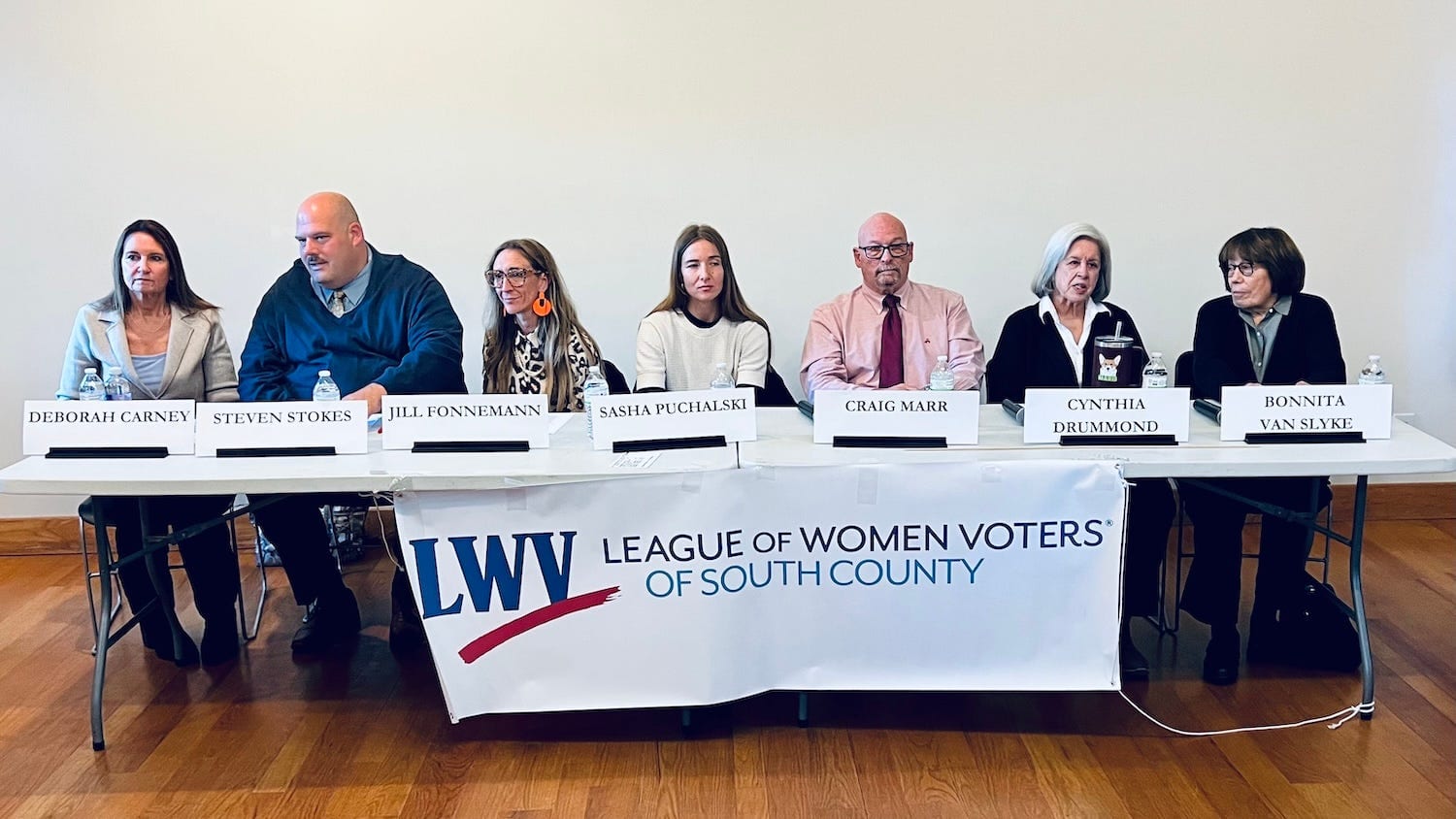
Charlestown voters got a clear look at where their town council candidates stand heading into this fall's election, as the League of Women Voters of Rhode Island and the South County Star hosted a candidate forum covering the issues that matter most close to home: housing costs, local control, and the long-running debate over a unified Chariho elementary school.
Seven candidates took part: Council President Deborah Carney (D), an incumbent; Council Member Stephen Stokes (R), also an incumbent; Jill Marie Fonnemann (D); Sasha Puchalski, running as an Independent; Council Member Craig Marr (R), an incumbent; Cynthia Drummond (D); and incumbent Bonnita Van Slyke, also running as an Independent. Matthew Westover (R) did not attend.
Torey Malatia, executive director of Literacy Volunteers of Washington County, moderated the discussion. Malatia spent more than four decades running public media organizations in Chicago and Providence and now sits on the board of the South County Star, the digital newspaper that co-sponsored the forum. Paul Roselli handled the videography.
As someone who lives right here in Charlestown and writes for the people who actually call it home rather than for visitors passing through, it's worth noting how much agreement there was among these candidates on the fundamentals, even as they differed on the details.
Housing affordability topped nearly every candidate's list of concerns. Carney said the cost of housing in town has made it nearly impossible for young families, working residents, and seniors to stay. Fonnemann echoed that, pointing to accessory dwelling units and strict environmental guidelines as part of the answer. Puchalski called for better town education on development limitations and for data-driven planning that serves local families rather than outside developers. Marr noted the town's lack of infrastructure makes the housing problem especially tough, while warning that Charlestown's aging population needs an influx of young families to sustain itself. Drummond tied housing to protecting the coastline, calling it the town's economic engine. Van Slyke and Stokes both stressed that local control over development, not state mandates, should drive solutions.
On specific fixes, Stokes favored focusing on rental units that can cycle through to new low-income residents rather than long-term restricted ownership units. Marr pointed to a potential partnership with Charlestown-based Habitat for Humanity and suggested looking at town-owned parcels. Puchalski and Marr both flagged a real problem: the town's Affordable Housing Commission has struggled to meet quorum, stalling decisions and prompting resignations. Van Slyke pointed residents back to the town's 2021 Comprehensive Plan and its affordable housing plan, which includes mandatory inclusionary zoning. Carney agreed a multi-pronged approach is needed, including requiring developers to include affordable units, but said the state also needs to revisit how it defines affordable housing long-term.
The Chariho school question brought out both support and caution. Most candidates, including Carney, Marr, Drummond, Van Slyke and Stokes, said they support the unified elementary school proposal, citing the poor condition of the current buildings, some nearly a century old, and the state reimbursement on the table, which candidates said could run between 60 and 65 percent. Carney noted that a previous, now-lost opportunity for three new town-specific schools could have brought up to 85 percent in state aid, and that every failed plan costs taxpayers roughly another million dollars to restart. Fonnemann and Puchalski were more cautious, raising concerns about traffic, the impact on fields like Wicklund, and the importance of hearing from abutters and affected families before moving forward. Stokes said he backs the unified concept but wants to make sure Charlestown's specific interests, including how costs and governance are shared among the three towns, are protected.
Asked what happens if the school bond fails, candidates were blunt. Marr and Drummond both said renovating the aging building is not a realistic option, calling it more costly than building new. Puchalski said the town would need to explore other funding avenues alongside Richmond and Hopkinton. Drummond put it plainly: the towns have kicked the can down the road long enough and need to decide one way or the other.
What it means for residents
For Charlestown residents, the forum made clear that housing affordability and the Chariho school decision will shape the next council's agenda regardless of who wins. Candidates across party lines pointed to the town's Comprehensive Plan and its affordable housing provisions as a starting point, while urging residents to get involved in town commissions that have struggled to find volunteers. On the school question, voters themselves will ultimately decide on the unified building proposal, with candidates largely agreeing that further delay will only raise costs.
Source: SteveAhlquist.news
More from us: scrinews.com

1 Comment
Pingback: Matos, Loughlin Spar Over Trump, Groceries and Gasoline in Second LG Debate – South County Gazette